The problem
SvitNail is a nail studio in La Jolla: hard gel manicures that hold for weeks, a waterless SMART pedicure, five artists, a calendar that runs in Mangomint. The work is excellent and the reviews say so. The problem is the one every salon has and nobody has time for.
A regular skips her usual month, then another, and nobody notices until she is gone. Left alone, one in 170 of them finds her way back in a given fortnight. A first-timer leaves happy and never hears from the studio again; only a third ever book a second visit. Someone reads the price list at midnight, closes the tab, and the studio never learns she was there.
The owner did not need another tool to look at. She needed someone to write to these people, at the right moment, in the studio’s voice, and to be honest about what came back.
The setup
Two things. She put 314 on the site and connected Mangomint. From that moment every visit, booking, cancellation and receipt landed on one profile per client, and 314 had the whole picture.
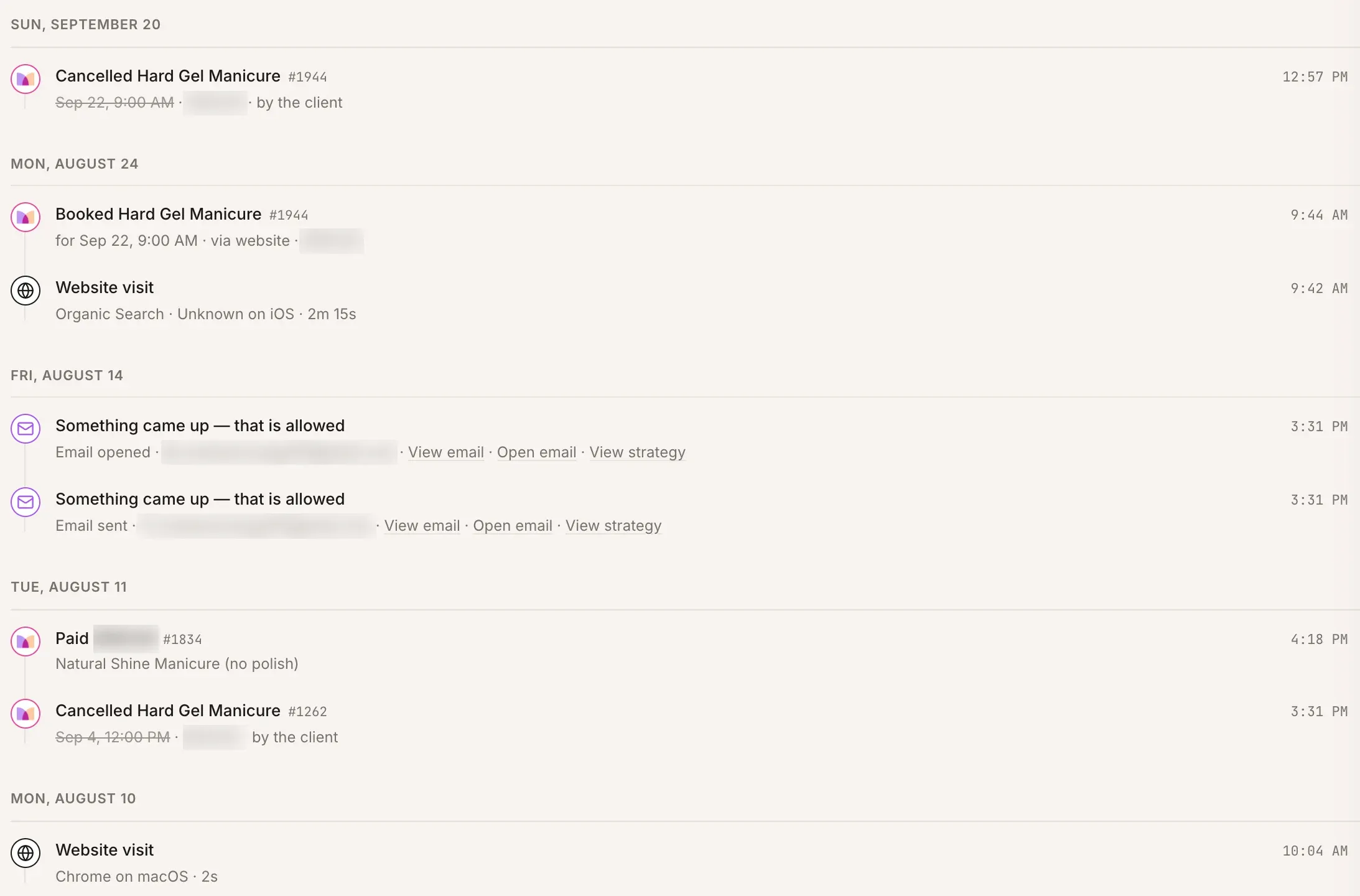
One client, one timeline: the site visit, the booking, the letter she opened, the receipt. This is what 314 reads before it writes.
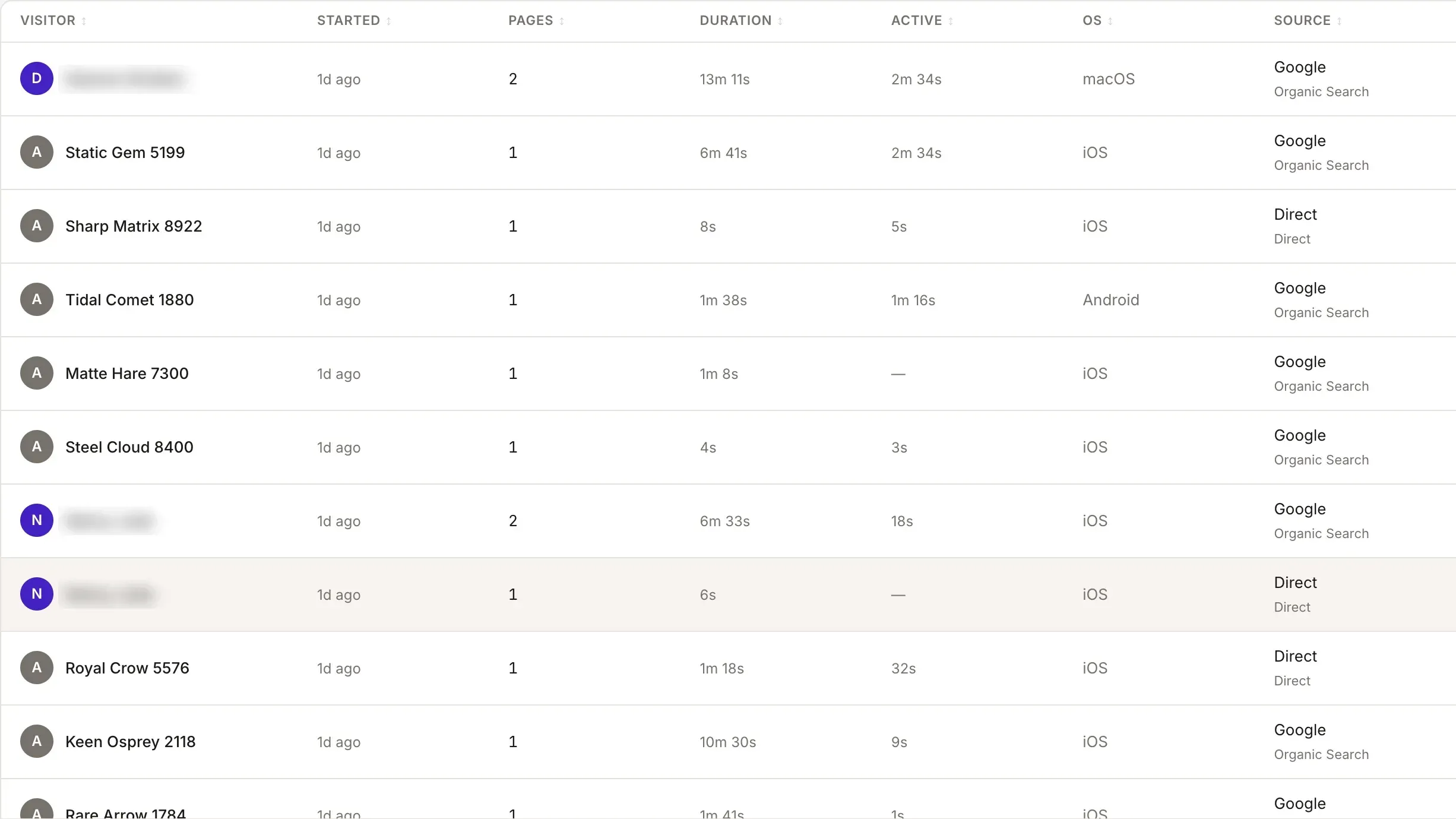
Every visit to the site as it happens. A client who has booked before is recognised by name; a stranger gets a name the moment she leaves an email.
Then she said yes. 314 writes to her when it has something ready: a sequence, a letter, a fix. She reads it, taps approve, and gets on with the studio. That is the entire job.
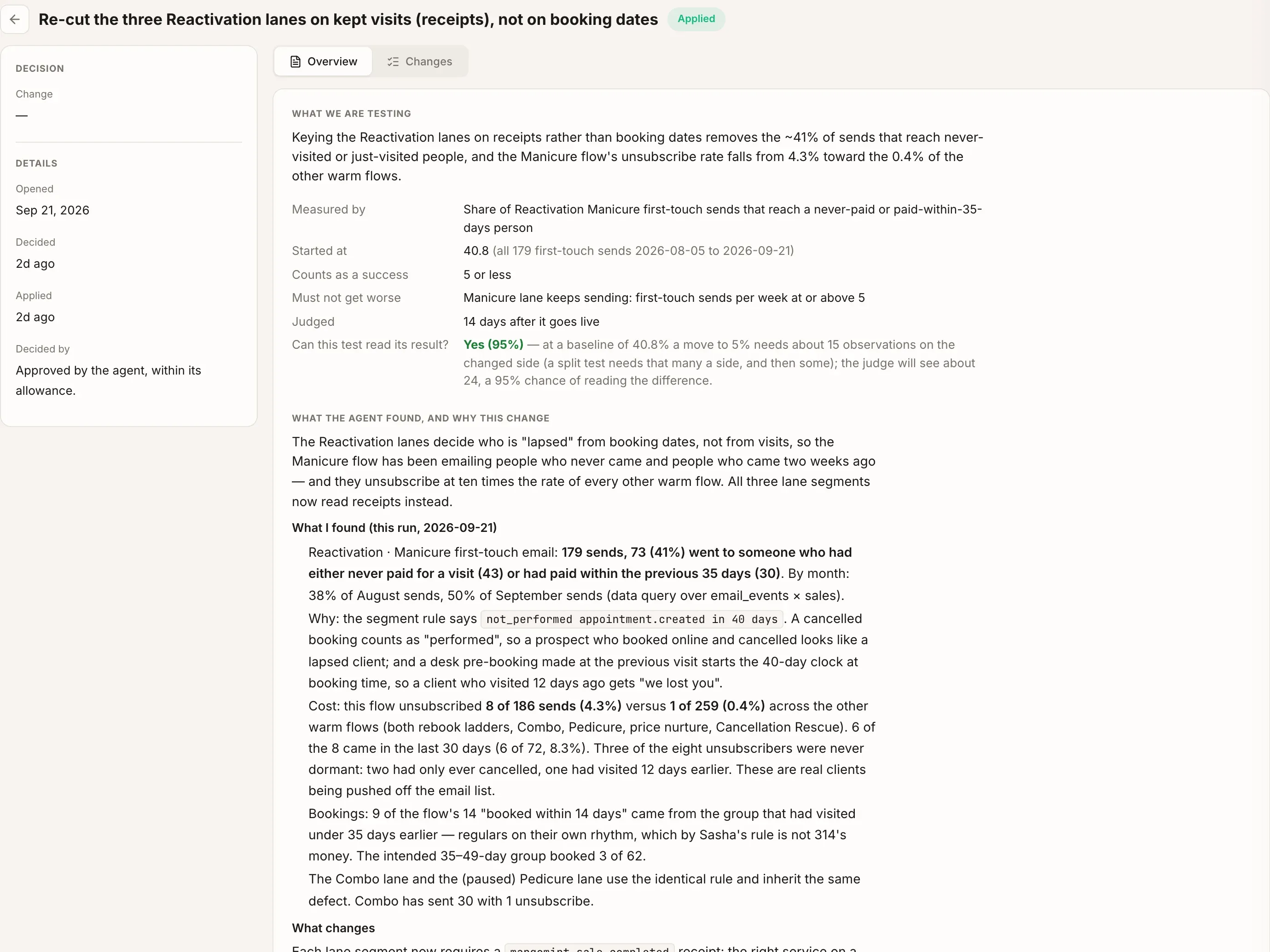
One decision, as the owner reads it: what is being tested, how it will be measured, the day it is judged, and what the agent found.
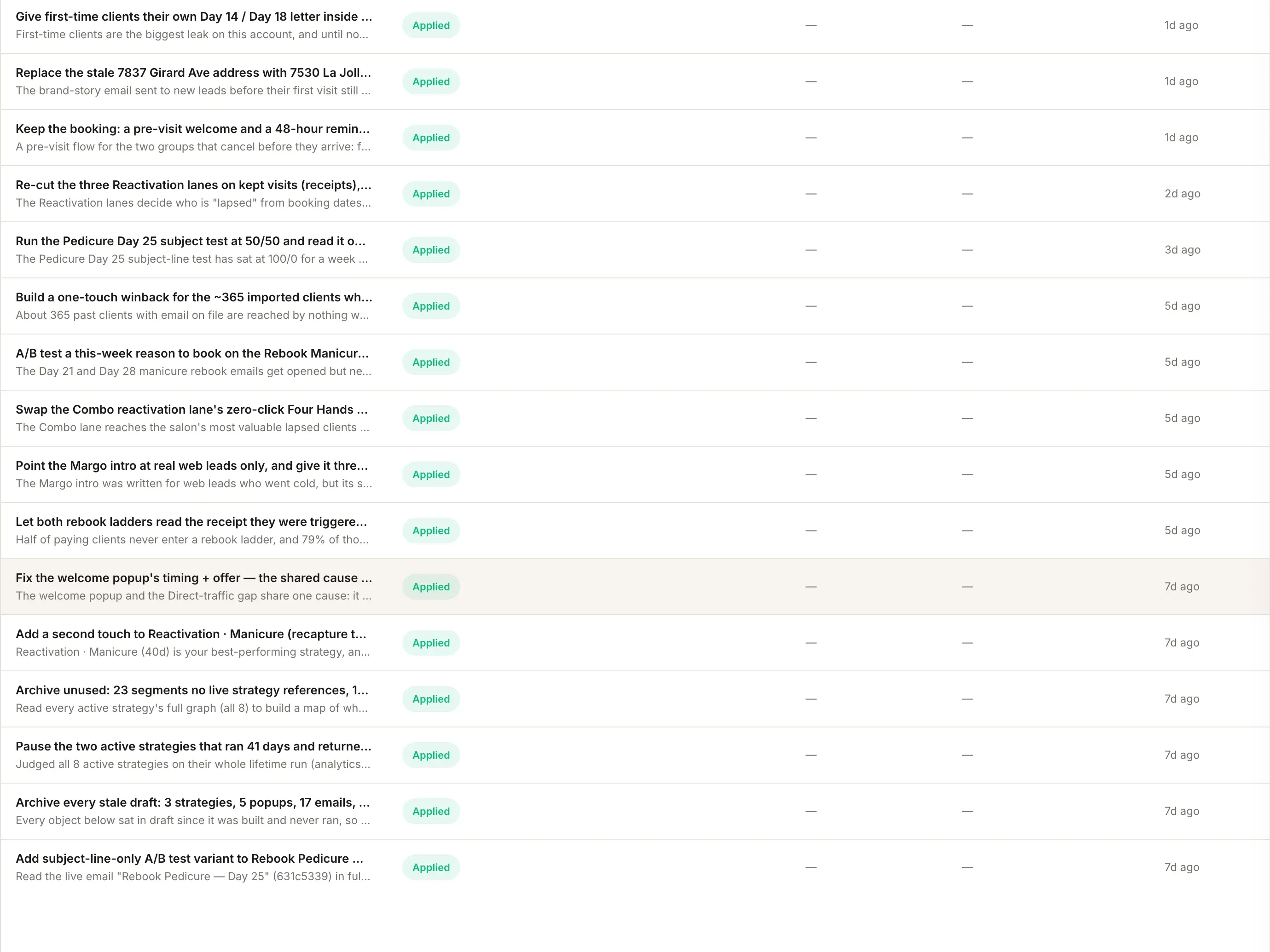
Every change the agent makes, in one list, one tap each.
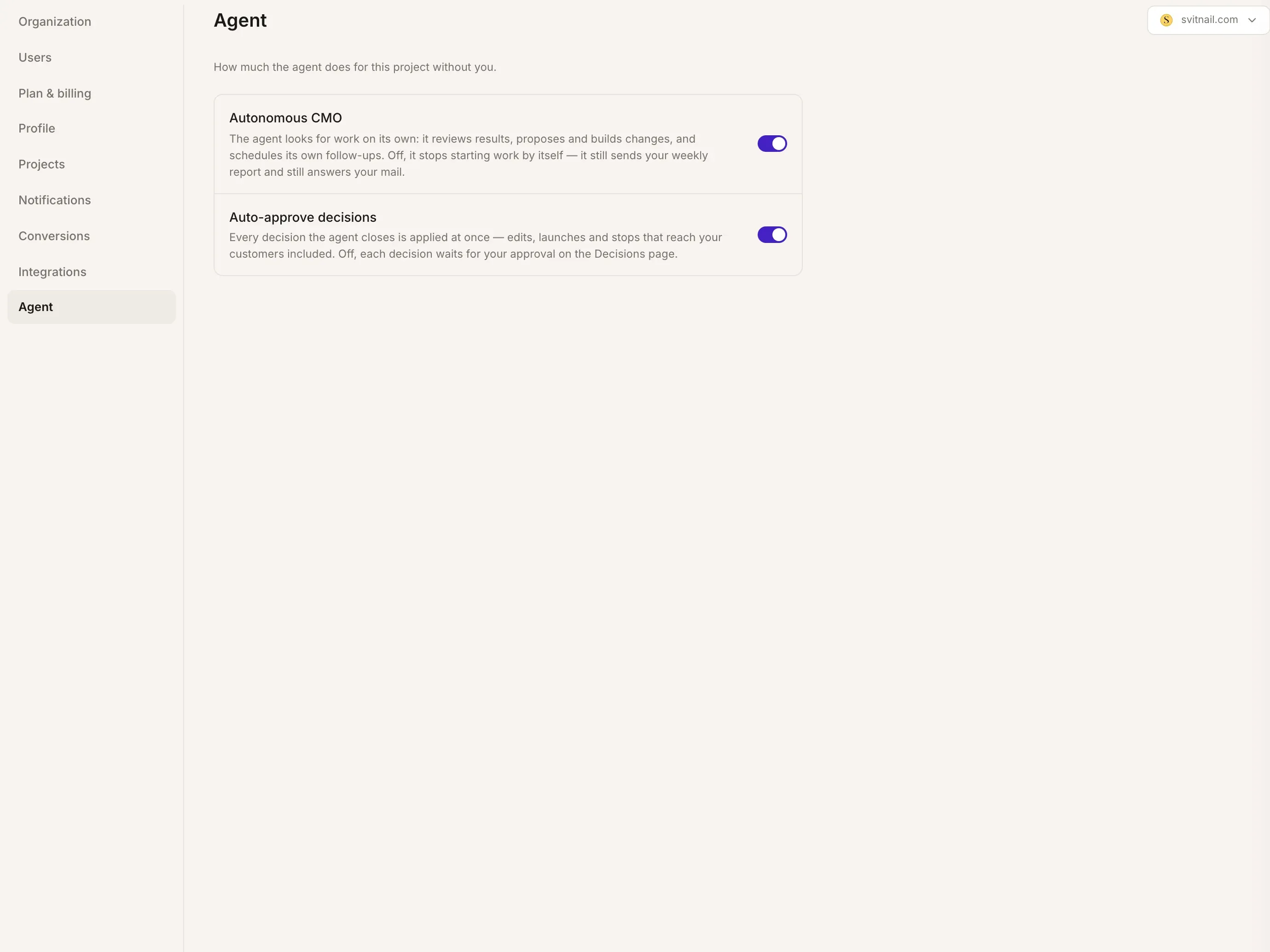
Two switches. With both on, the agent looks for work on its own and applies what it decides.
What 314 learned first
Before it wrote a word, 314 read the studio’s own receipts and worked out how SvitNail actually runs. None of it came from a template. Every figure below is the agent’s own count, the way it answers when the owner asks “how do you know?” in the chat.
1 in 3 first-timers come back
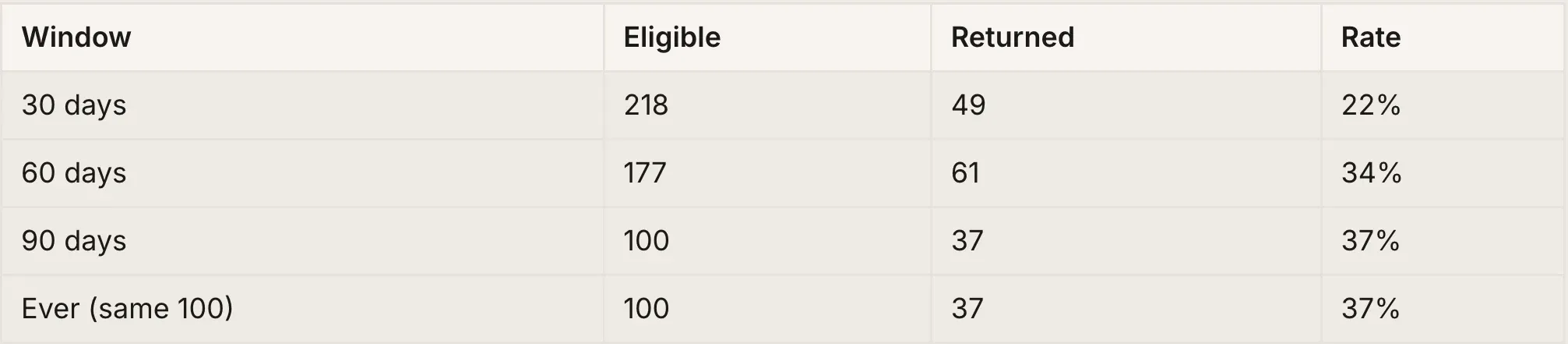
Half of that “retention” is the desk: half of the returners had booked their next visit before they left. The real audience for a letter is the seven in ten who walk out without a next appointment, and only about one in five of them comes back on her own. Pedicure first-timers come back least, one in five against one in three for manicure.
Rebooking peaks at week three
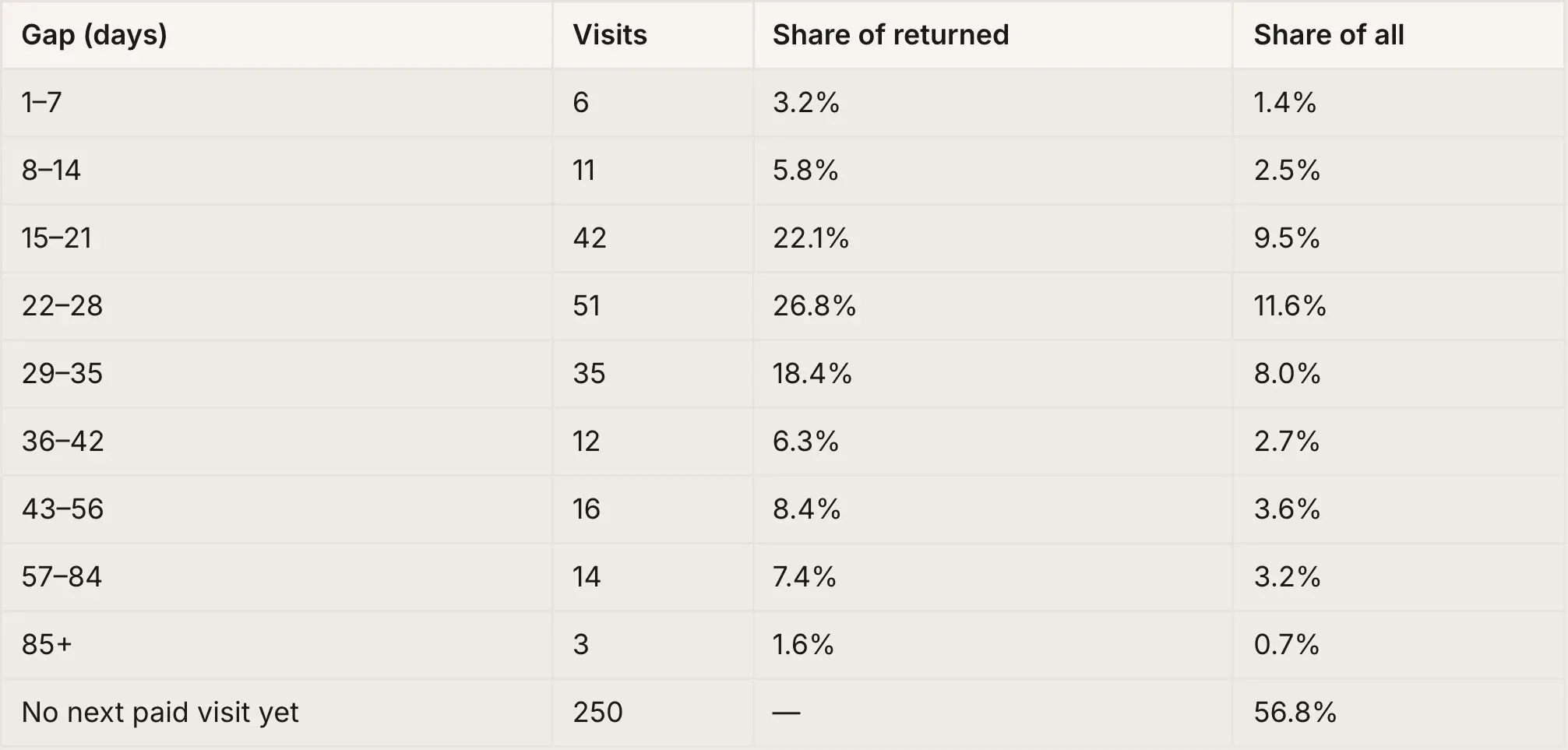
Hard gel grows out about three millimetres a month, and the studio’s clients behave exactly like that: almost nobody rebooks before day 15, two thirds of returns land between days 15 and 35, and the peak is days 22 to 28. A third of returners rebook on the spot at the desk; they never need a letter. The rest book online around day 24, only three to six days before the slot, when the nails are already grown out. So the letter lands at day 18, only to clients with nothing on the books, a week ahead of the decision instead of chasing it. Returns fall off a cliff after day 35, and that tail is where a second letter earns its keep.
Four in ten book a week ahead
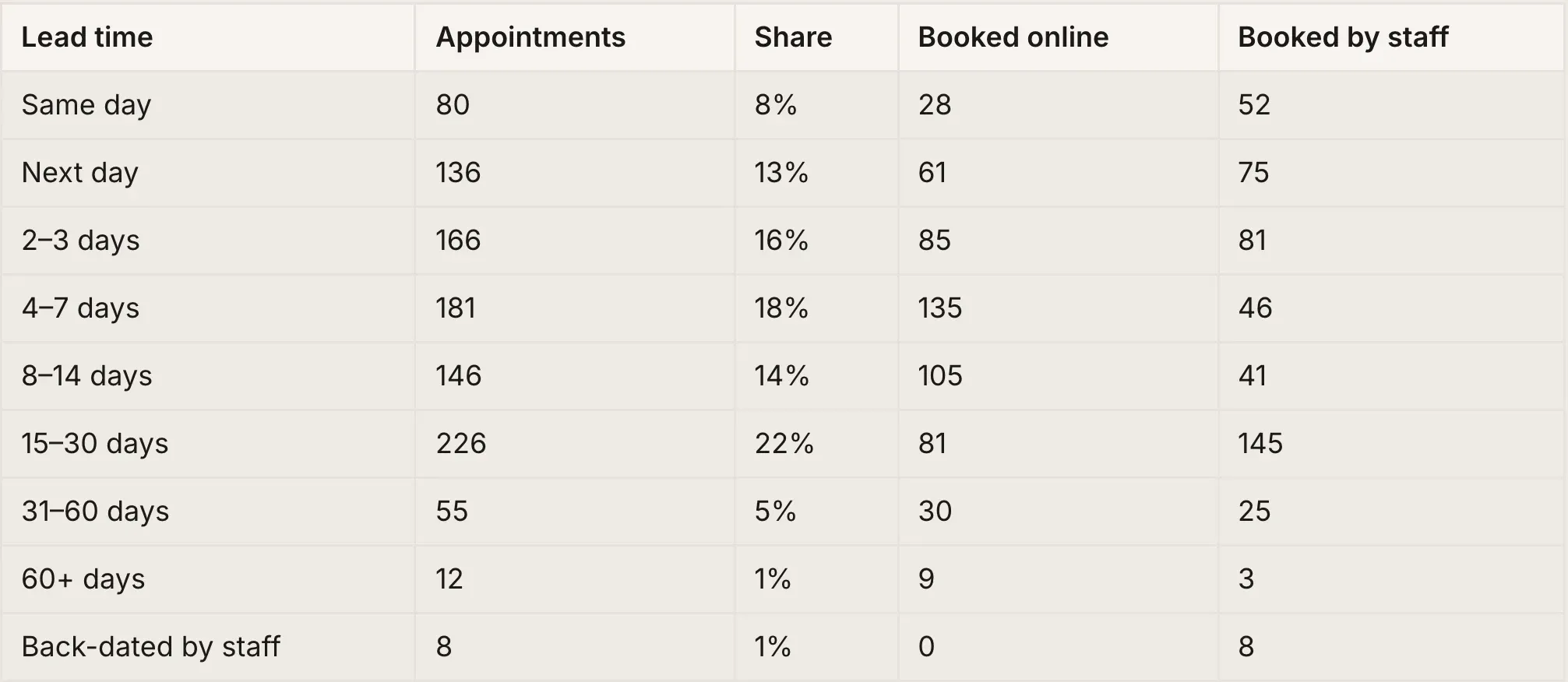
Two humps. Clients who book for themselves decide about a week out: over half of all bookings are made within seven days, online bookers at a five-day median. The second hump at 15 to 30 days is not planning, it is the artist booking the next visit at checkout: four in five of the staff bookings in that band were made on a day the client was already in the chair. So before any letter goes out, 314 checks the calendar. A client with a future appointment on the books gets nothing; a reminder sent blindly “N days after the visit” would land on the studio’s best clients as noise.
Cancellations are mostly reschedules
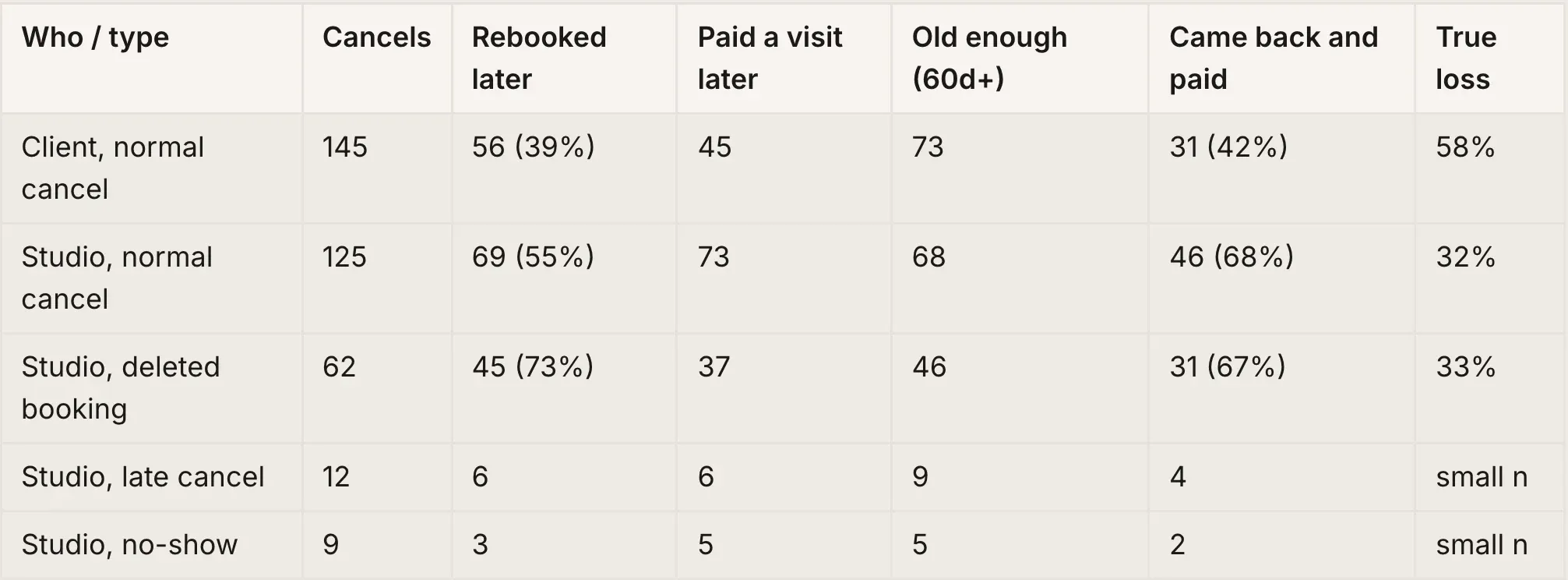
Studio-side cancellations are reschedules: two in three of those clients came back and paid, and the median gap to the new booking is a day or two. The loss sits in client cancellations, where six in ten never return, and it is deepest for first-timers: those who had never paid a visit come back a third of the time, against more than half for clients who had. The ones who do come back do it within a day. So the letter goes only to clients who cancelled themselves, and it goes fast, with one line: move it, don’t lose it.
The sequences
314 runs seven sequences for SvitNail. Five of them do most of the work: one turns a stranger on the site into a name, the other four each cover a moment a client is usually lost. Every one was built by the agent end to end: the segment, the graph, the letters. The letters were generated from the studio’s own site, its logo, typefaces, colours and photography, its prices and its way of speaking. Nobody at the studio wrote or designed any of it.
Welcome popup → price list
Why it exists. The site sees hundreds of people a week and cannot say who any of them are. Most first-timers decide on their very first visit to the site, so the moment to ask for a name is that visit, and the reason to give one has to be worth it: the price list, the studio’s story, the first-visit offer.
What it does. A visitor lands on the homepage and, after a few seconds, once, is asked for her name and email. The moment she leaves them the site knows her on every visit after, and two letters follow: the price list, then a letter about what a first visit at SvitNail actually feels like. If she books in the meantime, the sequence lets her go.
What came back. This is where the studio’s anonymous visitors become people: about a hundred left their email through this one popup, and every one of them got the price list and the studio’s story. Three in four opened the price list. One in ten has since booked a first visit, each one traced back to the popup.
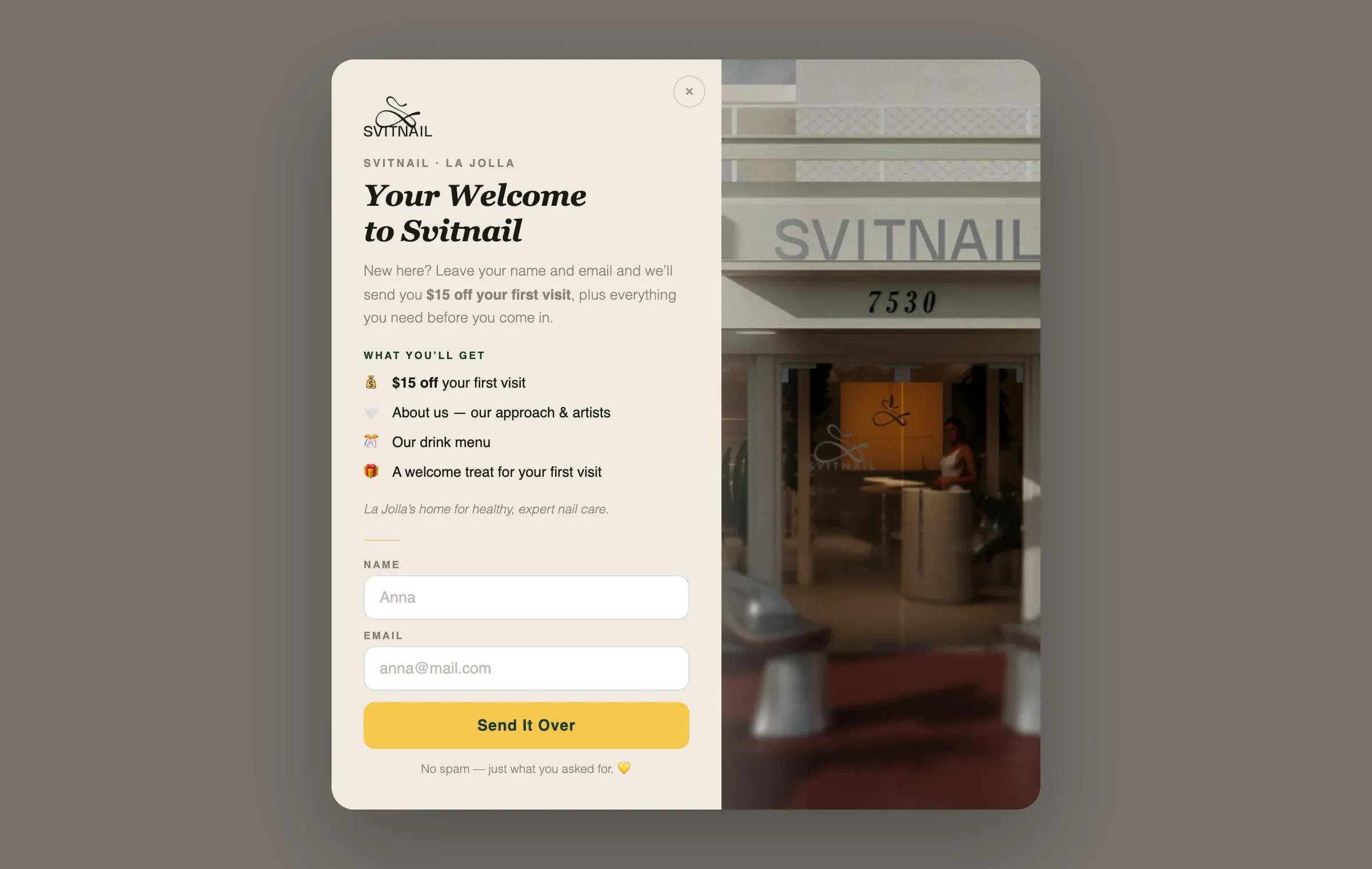
The popup, generated from the studio’s site: its logo, its storefront, its offer, its voice.
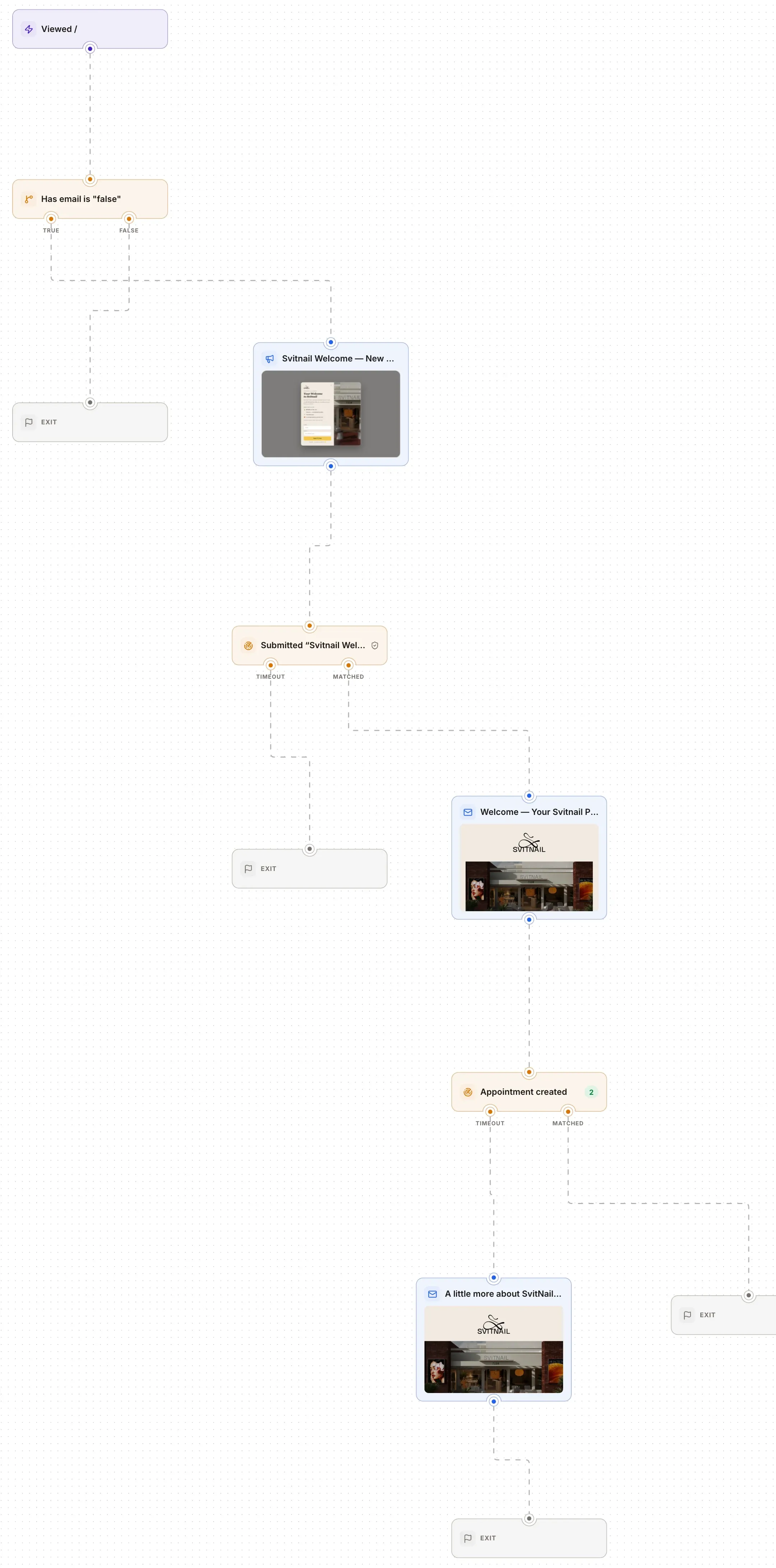
The graph. The popup shows once; a submitted email starts the letters, a booking ends them.

The price list, with what a first visit looks like and the drink that comes with it.

The second letter: who the studio is, how a visit feels, what is waiting.
Rebook Ladder · Manicure
Why it exists. Only a third of first-timers come back, and hard gel clients who do rebook do it in days 22 to 28, pressing “book” around day 24 for a slot a few days out. A letter has to land just before that moment, and only for clients who have not already rebooked at the desk.
What it does. A paid manicure starts it. Three hours later, a thank-you with the receipt link and one next-slot button, in a version for first-timers and one for regulars. Then fourteen days of silence; a client who rebooks at the desk or online leaves the sequence untouched. Then three letters, day 14, 21 and 28, with a booking check between each, and it stops after the third. A first-timer gets her own day-14 letter, because she does not yet know what a three-week-old set should look like.
What came back. Seven in ten of the clients who entered rebooked on their own before a single letter was needed, which is the point: the ladder writes only to the rest. Two in three of those open the letters, and one in seven books within the window the letter names.
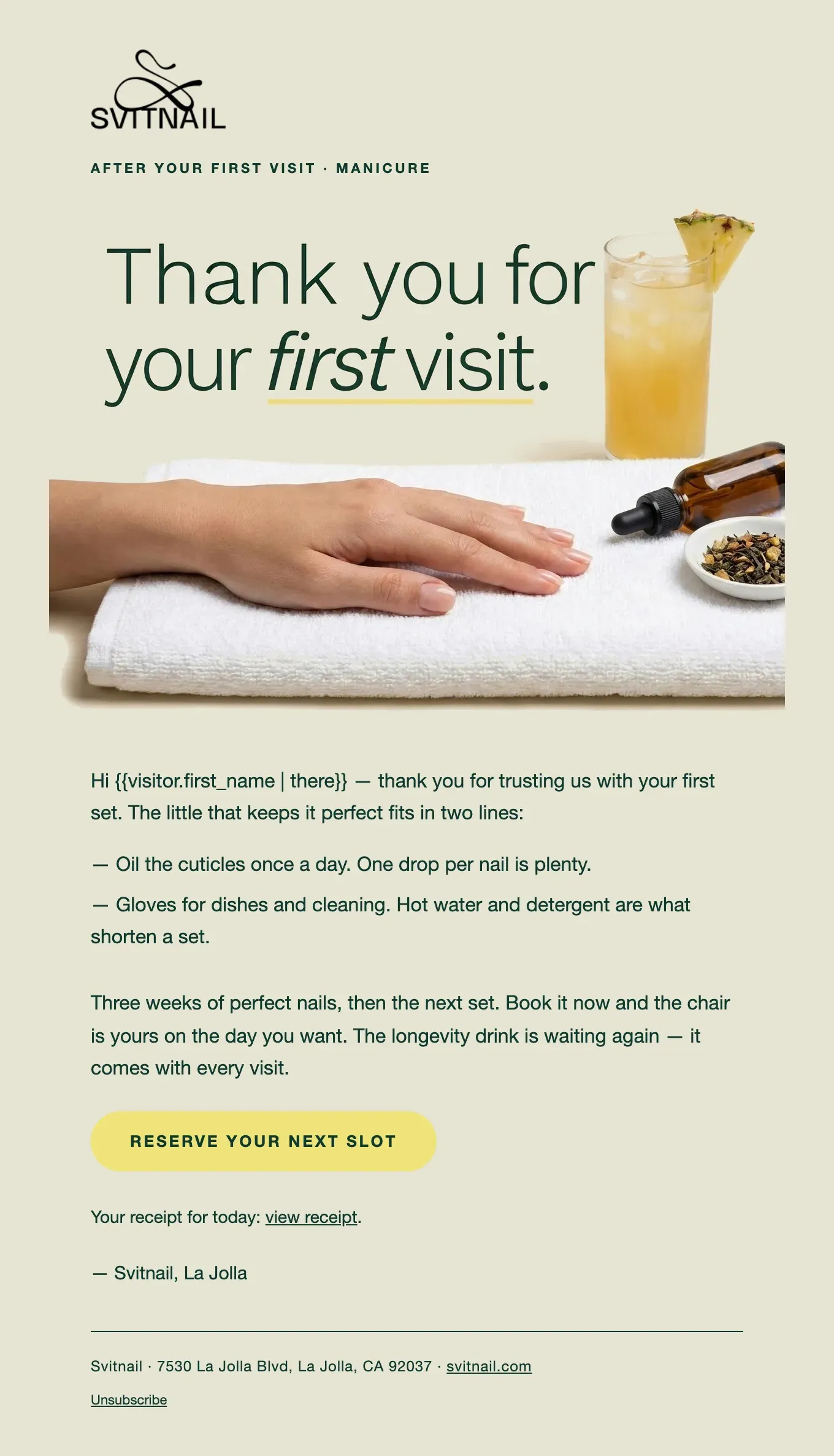
Three hours after a first visit: “Thank you for your first visit”, the receipt link and one next-slot button.
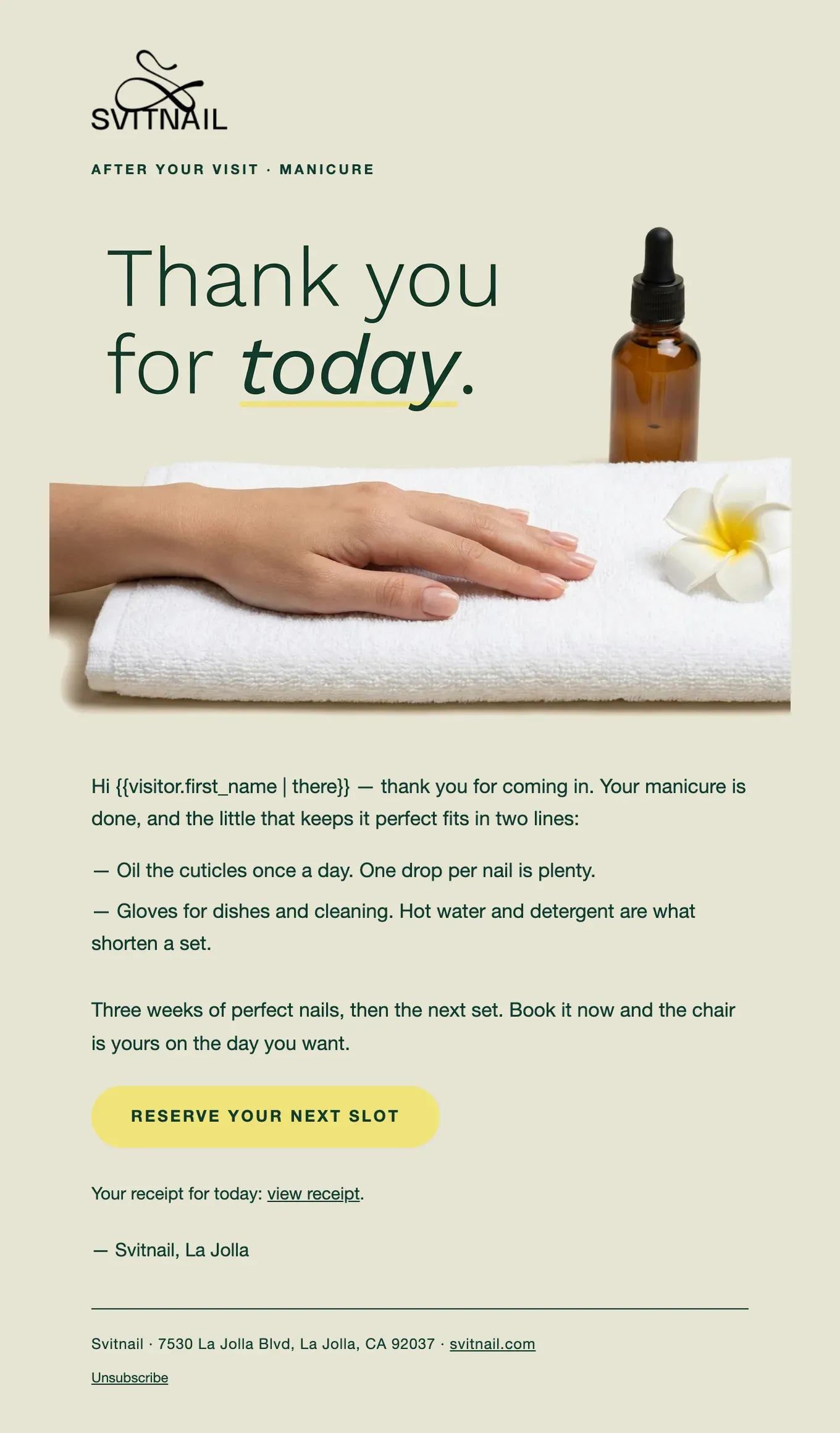
The same for a regular: “Thank you for today.” The headline is set in the studio’s own lettering inside the picture.
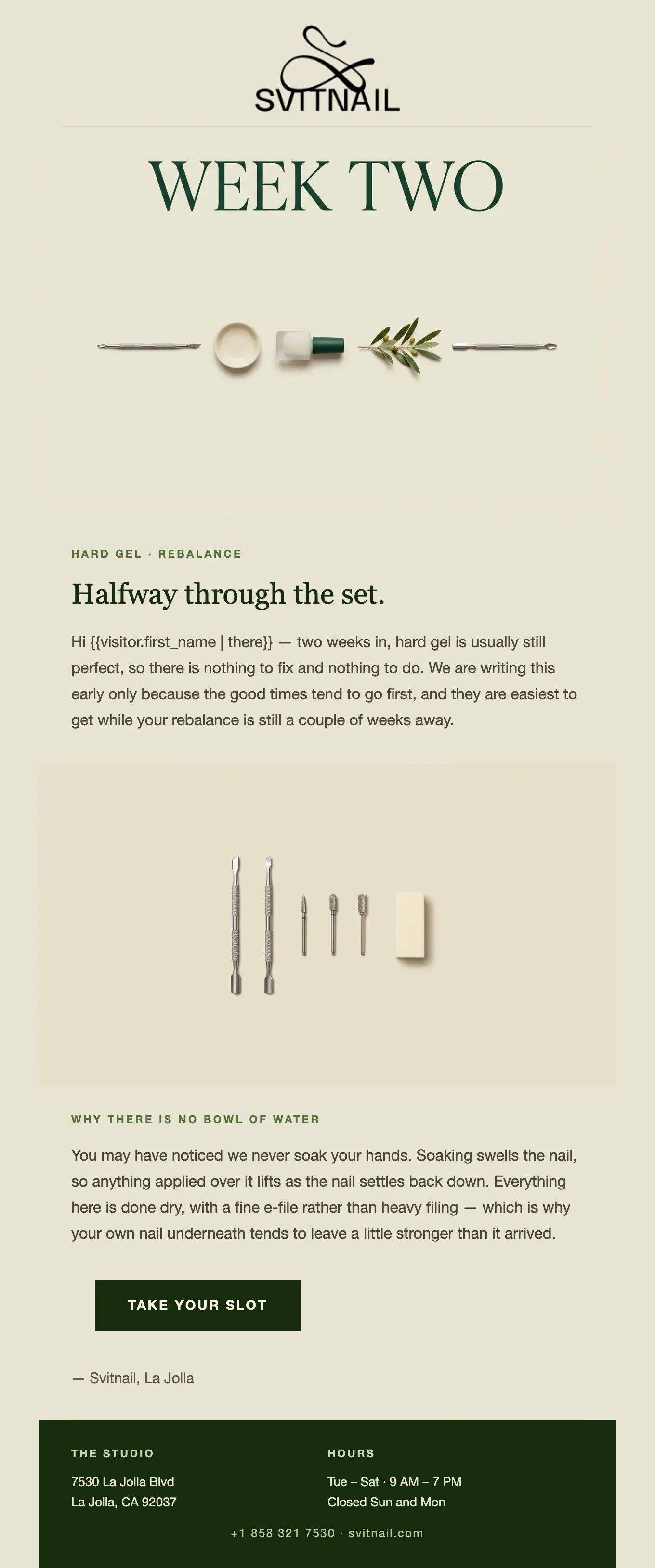
Day 14: “Two weeks in.” Nothing to fix yet, just the halfway mark.
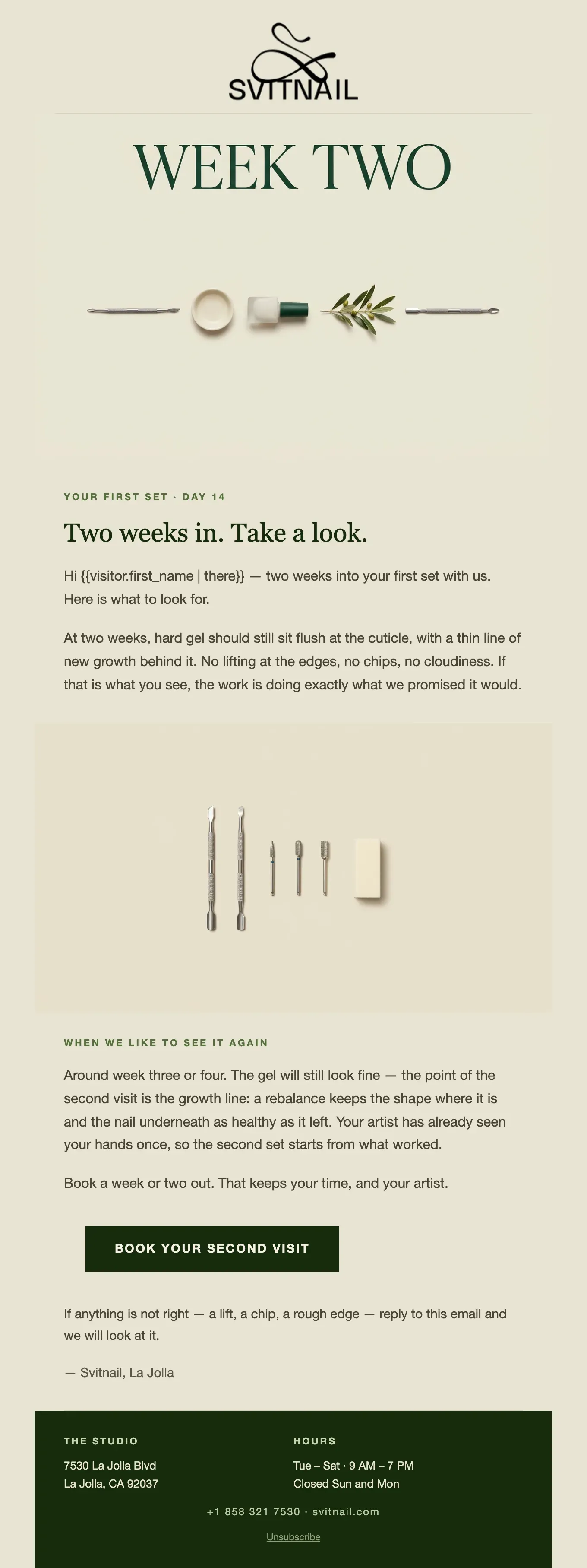
Day 14 for a first-timer: what the set should look like now, and when the studio likes to see it again.
Reactivation · Manicure
Why it exists. A manicure client who has been away 40 days has missed a full cycle and is still close enough to remember the studio. The lane is keyed on receipts, not booking dates, so a cancelled appointment never counts as a visit, and absence is checked again at the moment of sending, because the segment is recalculated overnight and she may have booked since.
What it does. One letter about what her nails have been doing while she was away, with the studio’s two services and their real prices, no discount. Fourteen days of listening for a booking. Then one more letter, the last, and the lane lets her go.
What came back. Two in three opened the letter. One in eight of the people written to booked within two weeks. Left alone, one in 170 of the studio’s lapsed clients comes back in the same window. Most of those bookings were caused outright, the rest helped along; this one sequence pays the fee on its own.

The first letter: three millimetres a month, and the two services with the studio’s prices.
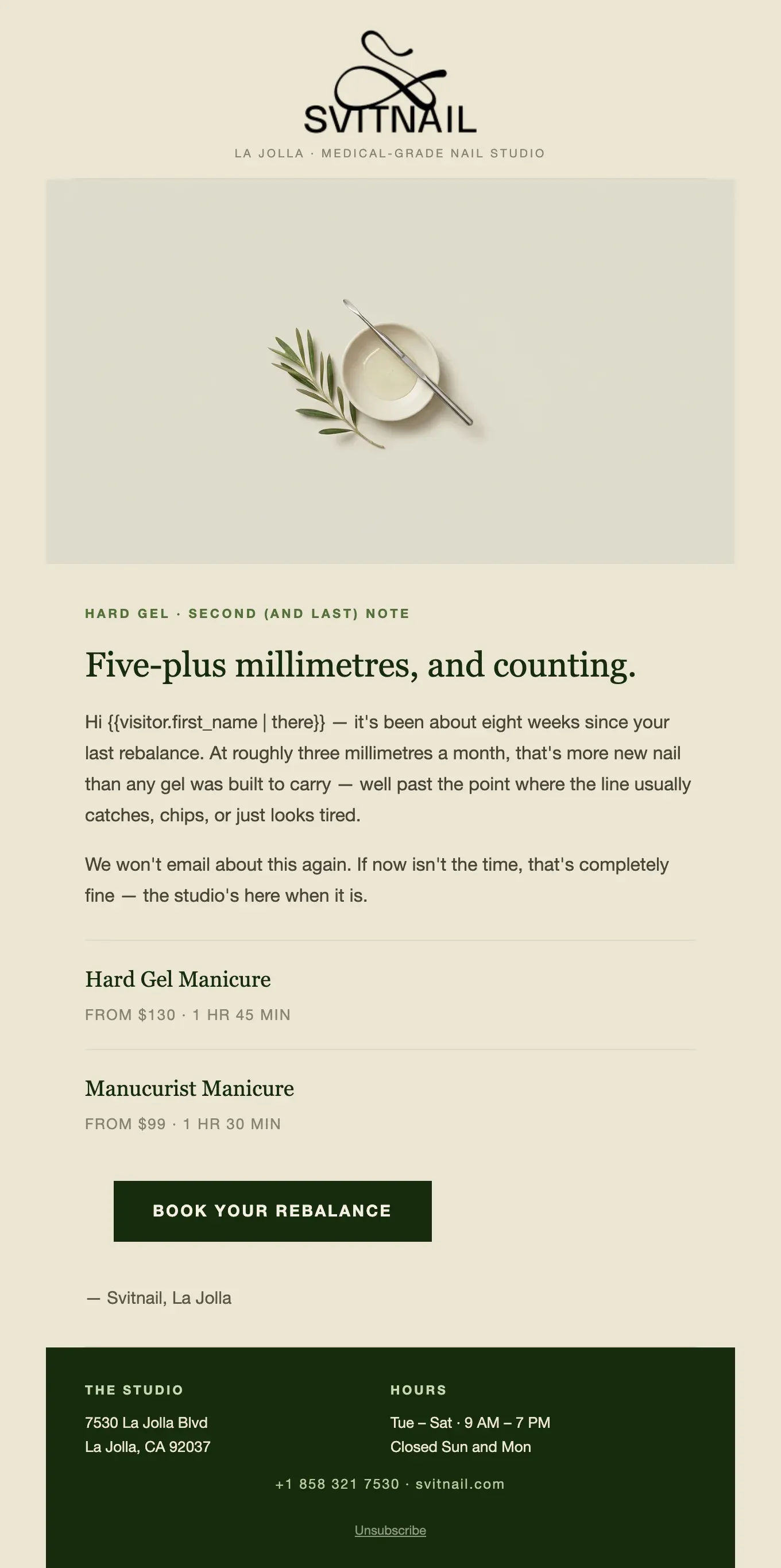
The second and last: “It’s grown more than you’d think.”
Keep the Booking
First-timers book far ahead, two weeks on average, and a long gap between booking and chair is where a cancellation grows. So a first-ever visit, or anyone written to in the prior two weeks, now gets a “what to expect” letter the day after booking and a reminder 48 hours before, with one line to move the visit instead of cancelling it. A cancelled or rescheduled booking exits before the reminder, so the old time is never quoted back. It is judged on the share of these bookings that end in a paid visit, on a date the agent already set.
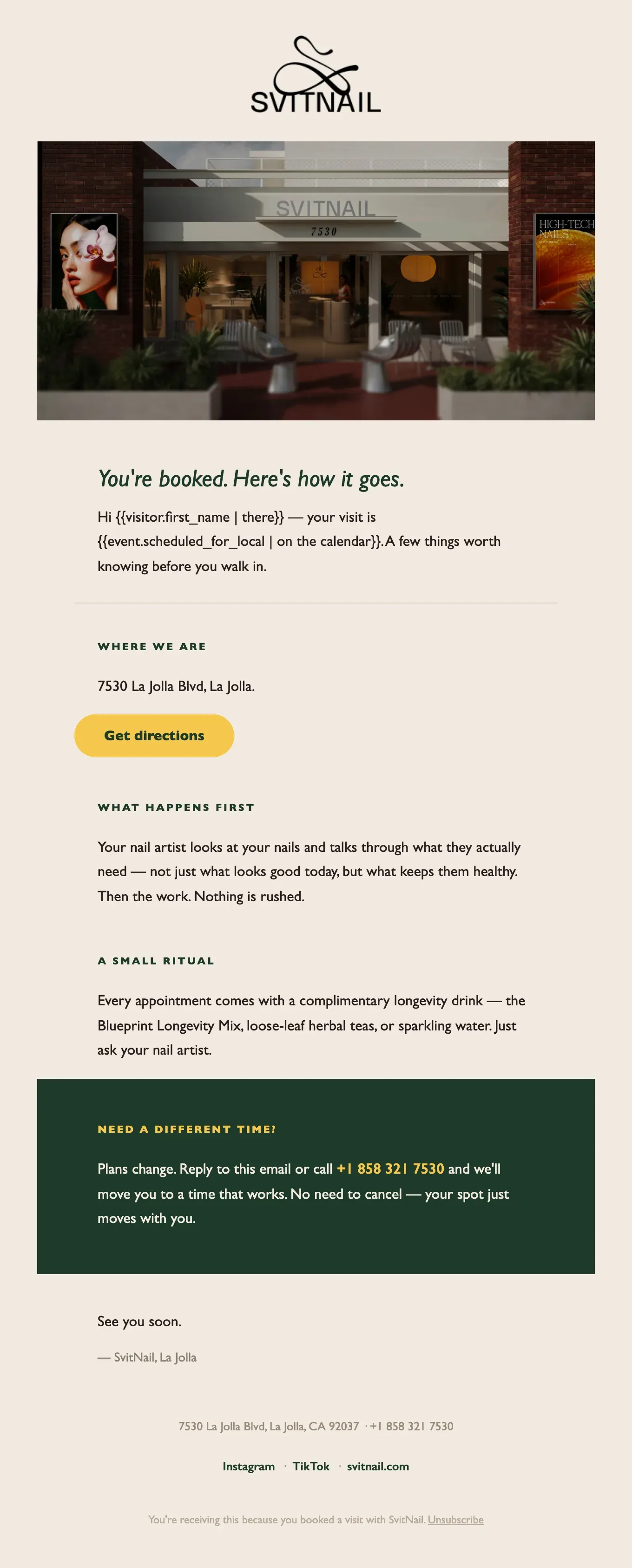
The day after booking: where the studio is, what happens first, the drink that is waiting.
Winback · Past clients
Hundreds of past clients came in from Mangomint with no site history, and no other sequence could see them. They got one note naming this week’s openings, prices as on the site, after a three-day listen so it never lands on top of a fresh booking. The letters went out on a Monday; by Wednesday two in three had been opened. Bookings are judged over the 21 days that follow.
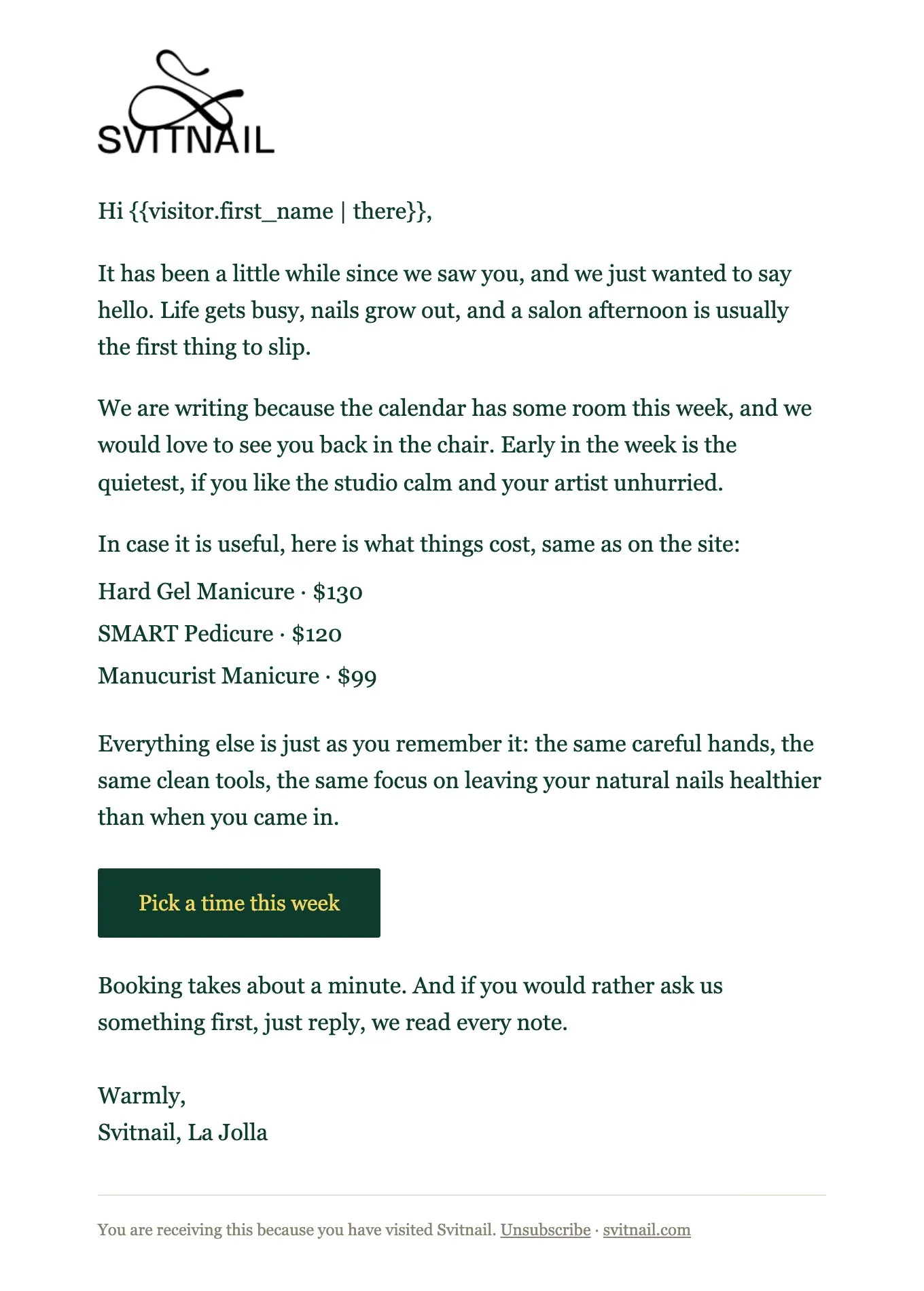
“We have a chair for you this week.”
What the agent did after launch
Once the sequences were running, the agent’s work changed from building to reading. Every letter has an Analytics tab: sent, opened, clicked, unsubscribed, per variant, and under it every client the letter reached and what she did with it. The agent reads these the way a marketer would, and when it finds something it opens a decision: what is being tested, how it is measured, what counts as success, what must not get worse, and the day it will be judged. Then it applies the change and comes back on that day. Three of the things it found at SvitNail.
Half the paying clients never entered a ladder
The rebook ladders start from a receipt, but a gate at the door checked for a booking in the last seven days, and a quarter of the studio’s clients book two weeks ahead. Reading its own numbers, the agent found that only a third of paid manicures were getting past the gate, and the ones turned away were exactly the clients the ladder exists for. It rewired both ladders to read the receipt’s own line items instead. In the first five days after the change, the share of paid manicures entering the ladder went from 37% to 69%: the ladder now sees twice the clients it did.
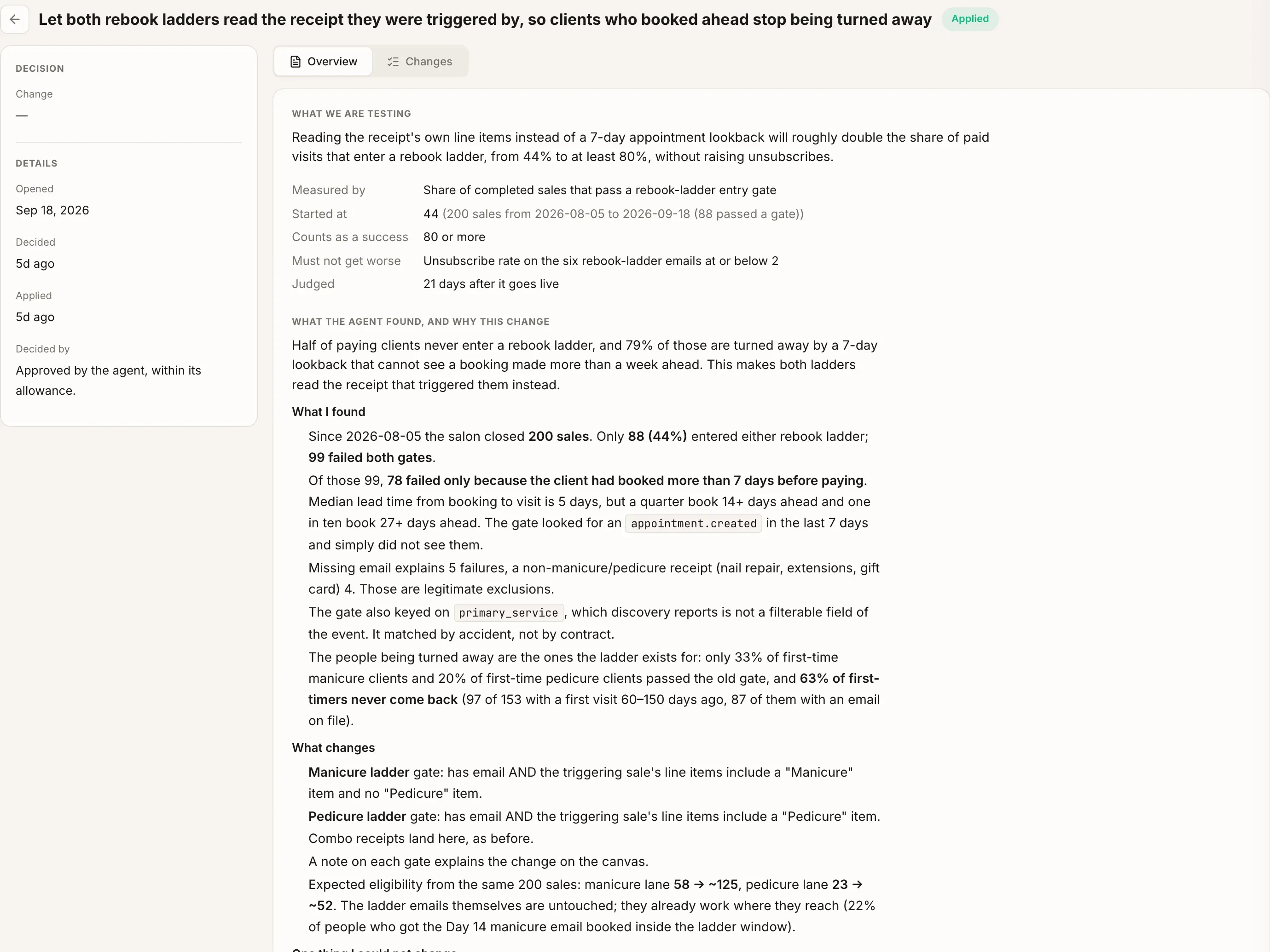
The decision: three in four of the clients turned away had simply booked ahead.
The best sequence was letting 130 people go
The reactivation letter was the studio’s strongest, and reading the strategy’s own numbers the agent saw the other side of it: two in three of the people it wrote to had timed out after the one letter and left as “went quiet”. Nobody heard from the studio again. Every comparable sequence used two or three touches; this one used one and earned the most. The agent wrote a second and last letter, “It’s grown more than you’d think”, and wired it in after the fourteen-day wait. The owner approved it in the portal; the 130 are getting it now.
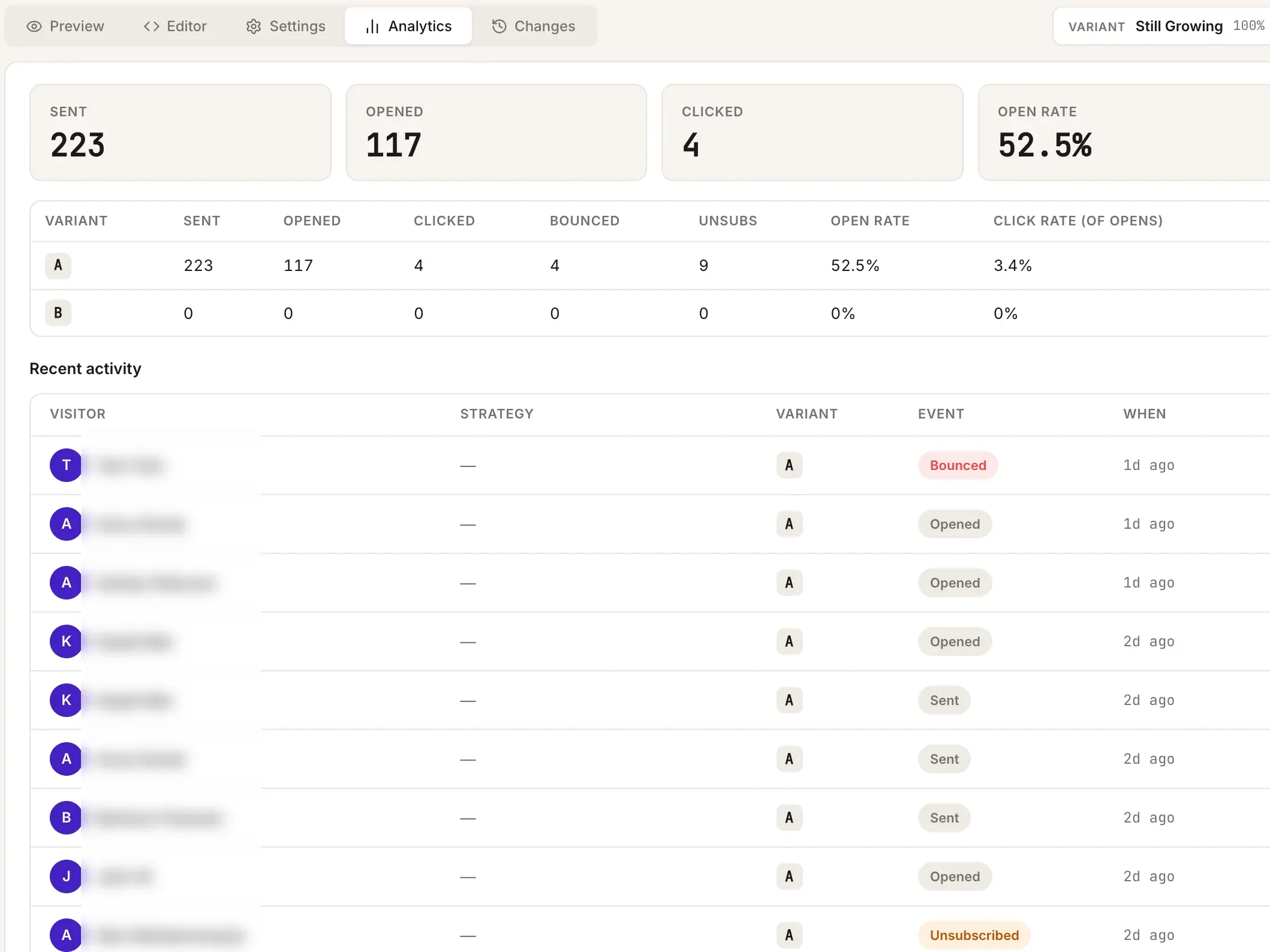
The letter’s Analytics tab: sent, opened, clicked, unsubscribed per variant, and every client it reached.
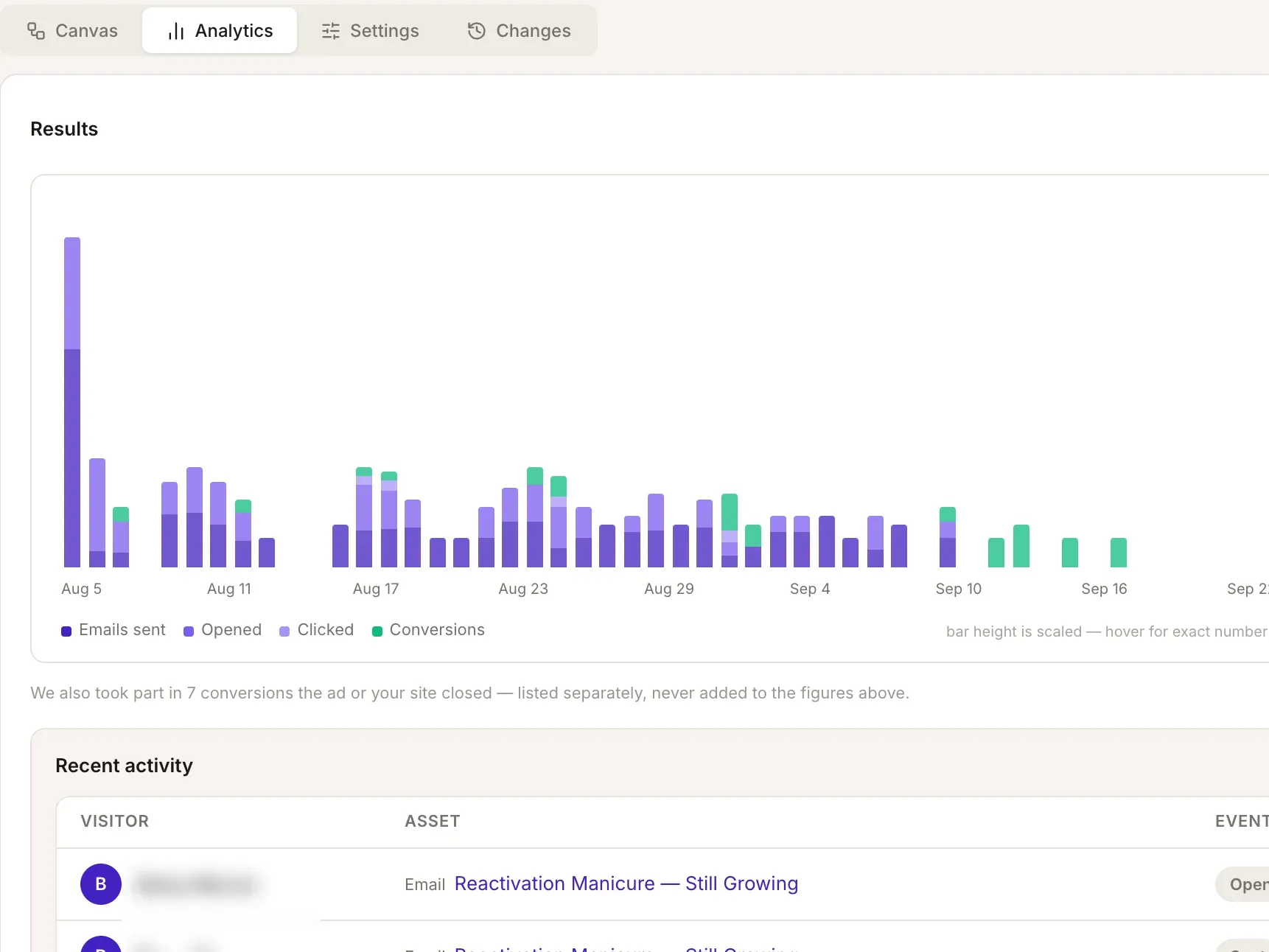
The strategy’s Analytics tab: letters, opens and bookings day by day.
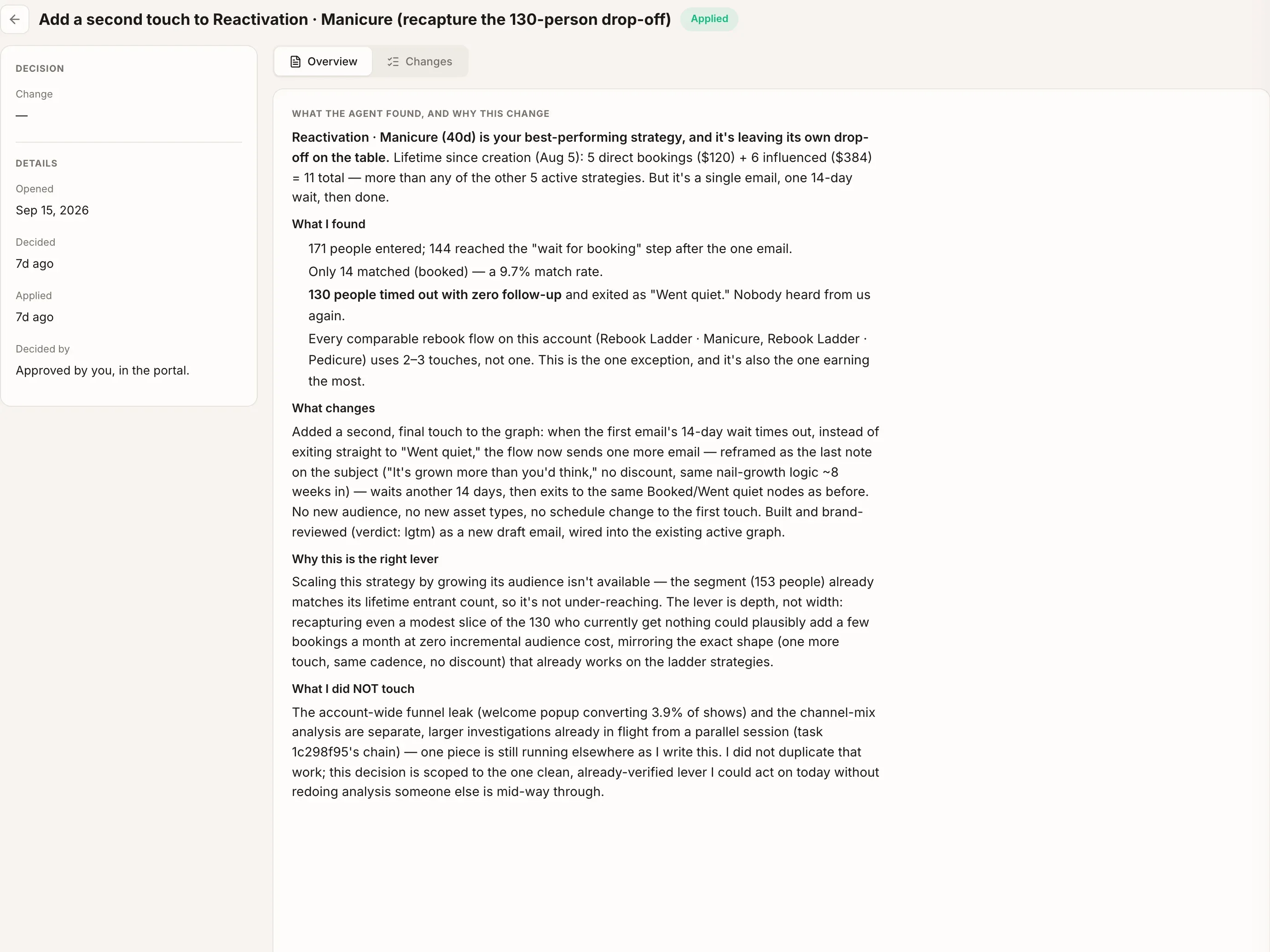
The decision: 130 people timed out with zero follow-up. One more letter, same cadence.
Two letters that open but never click
In the manicure rebook ladder the day-14 letter was clicked by one in five of the people who opened it. The day-21 and day-28 letters, same template, same sender, same button, were opened just as often and clicked by nobody. The agent read the copy: day 14 says the slot is easiest to take now; day 21 says “most of our regulars land right about here” and day 28 says “book when ready”. The same split held across the whole account: the letters that get clicked name openings this week, and every zero-click letter tells the reader there is no hurry.
So each silent letter got a B variant at 50%, with a concrete this-week reason to book and nothing else changed. The agent noted the caveat itself: day 21’s audience is what is left after day 14’s bookers leave, so part of the gap is attrition, which is why it is a 50/50 test on the same audience rather than a rewrite. It is judged on click-through at 45 days.
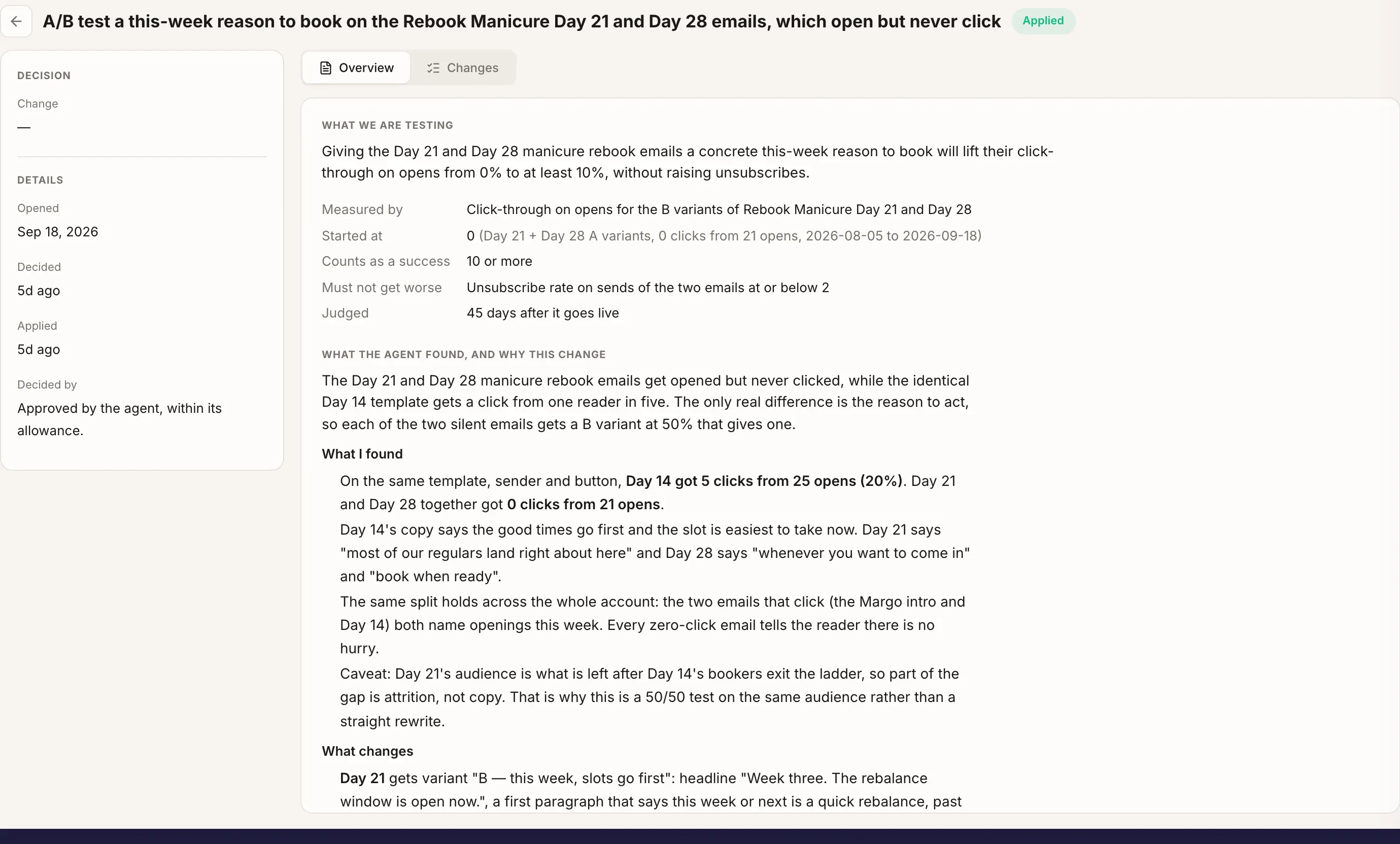
The decision, with what the agent found, the caveat, and what changes.
Every change above has a date the agent will come back on, and every Monday it writes the owner what moved and what is waiting on her.
The result
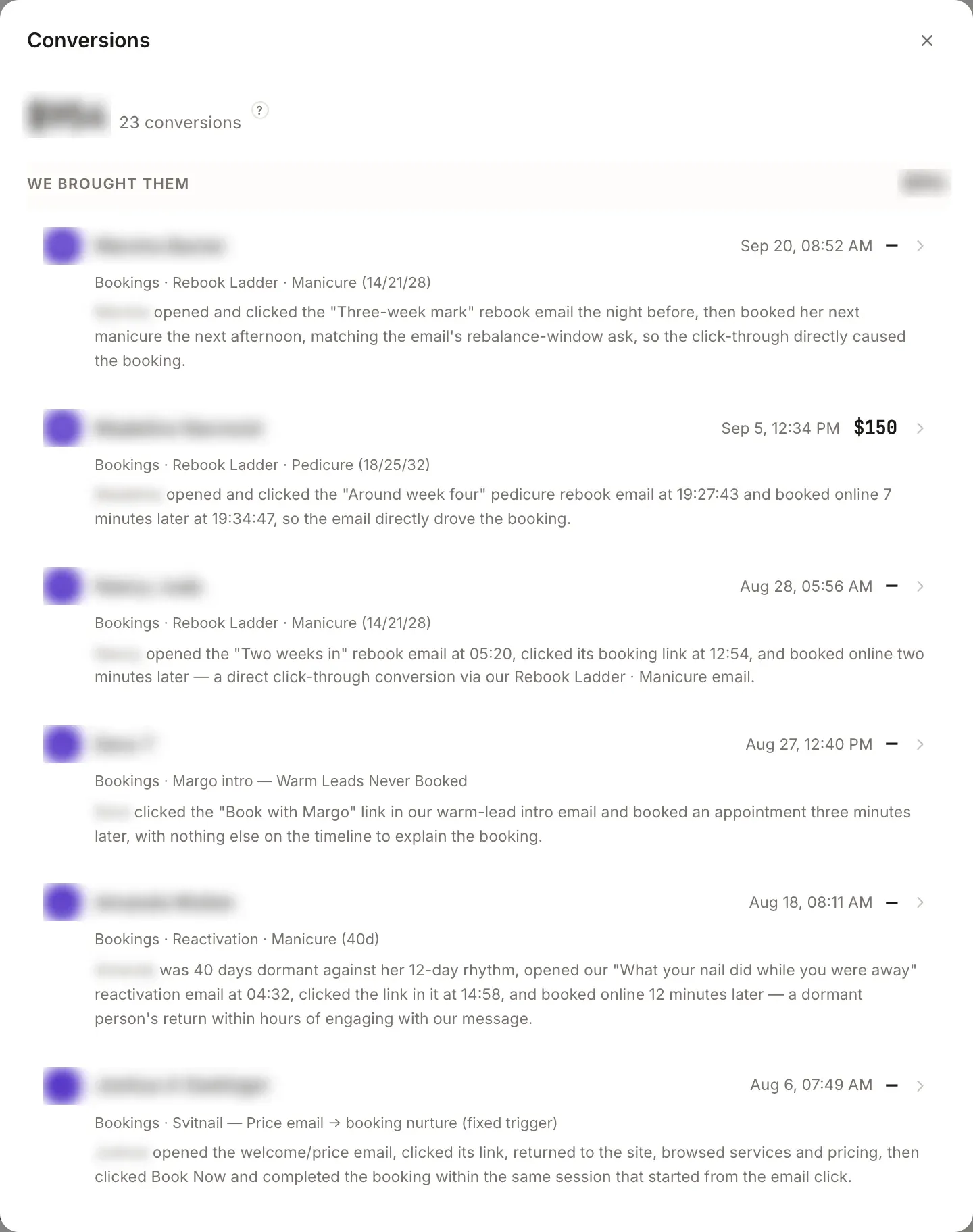
Seven weeks in, SvitNail gets four times its fee back. That counts only the bookings 314 caused outright, each one read against the client’s whole timeline; the ones it merely helped along are listed apart and never added in.